Wednesday, January 8, 2014

The War On Poverty 50 Years Later

Today marks the 50th anniversary of President Lyndon Baines Johnson declaring war on poverty. Over those 50 years the percentage of people living in poverty in the US has declined from 19 to 15 percent. At the same time the actual population of people living in poverty has risen from 36 million to 47 million today because of the population increase over the last 50 years.


Now, it is a simple thing to declare this something of a success with the perennial qualification of "but there is still much work to be done". At the same time, those on the other side of the political spectrum can just as easily claim it to be a Pyrrhic victory  because, for all the financial, political and emotional resources that have been expended in this "war", a 4 percent decrease is indicative of a waste of time.

It has already been shown from all that has gone before that neither side will win an argument as to the validity or even the existence of victory in the eyes of the other. However, this has as much to do with how the problem of poverty has been framed and it's supposed solutions derived as it does with partisan opinions. 

Poverty is and has always been a serious problem and a stain on the honor and conduct of any nation that has willfully allowed practices that dispose people to it. Although it is also true that poverty in much of the rest of the world is relatively and actually far worse, it is none the less the case that to the degree to which it exists here, it is unacceptable.  These are high ideals and high ideals are required if a society wishes to aspire to something greater than it is now. However, as always, what goes unseen is more important than what lies on the surface. 

Poverty, and the so called war on it has become nothing more than a convenient rallying point for differing political positions to gain legitimacy by seeming to do something without doing anything at all. This is not an indictment of any politician or political position in specific, but simply a description of what has been the case as long as people have appealed to mass society in order to gain favor. A four percent decrease over 50 years is not indicative of a dysfunctional government hampered by partisanship, but rather that the programs in place have maintained the status quo at best and kept people in poverty at worst. 

It is far easier to appear to be doing something when the measures of success are unclear or non-existent than it is to actually do something meaningful that lasts. As has been said before though, even those with the best intentions in the current system are and will be restricted by the nature of the system itself. In a world of finite resources in which a zero sum game is the regime, zero will always be the sum. No amount of policy and legislation will solve something as deep as human suffering. Thus it is better to stop waiting for such to come about and campaigning for it as if it were a life and death struggle. It is better to actually act on supposed personal ideals and do something. 

Doing something does not require quitting your day job. It does not so much even require going out of one's way. What it does require is putting words to action. The poor are closer than you think. Many of us avoid their neighborhoods on our way home every day. Many of us ignore them when we pass them on the street corner. Many of us claim we are too busy to pay attention, or too broke to contribute to legitimate organizations dedicated to providing for those in need. 

Until we start fighting the war on poverty one individual at a time, why should we expect something as systematic and machine like as the government to do a human's job? Some may complain about freedoms being limited. The freedom to have compassion is not, and it benefits all who take advantage of it.  
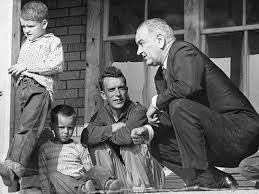
LBJ did because he experienced it first hand

Sunday, January 5, 2014

Too Big Not To Fail

It has been said a few times before how what goes unseen often matters far more than what is on the surface, and how what you don't know can actually kill you. This becomes increasingly the case the larger a system becomes. The larger as system is, the more difficult it becomes to track what is going on in it. Regardless of our many abilities, the human mind is only able to process so many things at once. It's why we have a parasympathetic nervous system. There is too much going on to be conscious of it all at all times. This does not seem to stop us from deluding ourselves into thinking we are though, and in that fantasy, much risk goes unseen.

The real trouble comes when that risk is hidden in the form of things that seem externally to be good. For example social programs to alleviate poverty that leave poor people more dependent and more poor than they were to begin with. On the other side of the political spectrum, strong pro-life positions that leave the movement looking like a group of bigoted, and completely out of touch hate mongers. the road to collapse and irrelevance is paved with good intentions poorly thought out and atrociously executed. 

At the same time, we continue to make the same mistakes. The reason is, with so much going on beyond the scope of human ability to accurately track, we substitute good feelings about a course of action for measured and accurate judgements. In the current modern world in which it is possible to aggregate so much noise and distraction, emotion speaks the loudest. It always does. However, in times passed, Babylon was a quitter place. One in which thoughts could be collected and judgements more thoroughly measured. None the less, hoping for a return to some passed golden age is as futile as predicting the next one. 

The long range trend of a complex system, which our political/social system is, is to grow more inwardly focused and thus more chaotic in the same way a feedback loop builds to ear piercing shrillness before you move the mike away. Counter intuitively, the larger the system is, the more assured you are of this entropy building. The reason is because large systems become stable and do not need to compete in the same way smaller ones do thus quickening the trend to inward focus and ultimately chaos.

The system becomes too big not to fail. Then again, chaos leads to destruction and recreation. To use the modern term, it breeds innovation.  It is incumbent upon the individual to recognize this and take advantage in such a way that leads to the betterment of that outside him or her self. We cannot keep track of everything, but we can recognize that which is close to us and we can influence it. This is a far more balanced approach than being swayed by the wind of whatever is trending right now, and influencing that close to you is simpler than it may seem. 


Wednesday, January 1, 2014

NEW YEAR

We in the modern world liked  to take advantage of the New Year, not only to drink ourselves to making choices soon to be regretted, but also as a boundary of sorts. The end of something before and a chance for new beginnings. As with everything though, it is not so much what is apparent on the surface, but what goes unseen.

Resolutions, grand plans, any decisions for that matter are not as important as what happen after you make up you mind. the best intentions mean nothing if they are not sustained and closed on. These follow on actions are what we do not now see. However, they make all the difference in the ultimate outcomes. 

Thus who can say what lies ahead for we do not live in the future? The one thing that is within our reach though is our own will, if we so decide to take charge of it. 

At the same time, opportunity is opportunity. And so take charge and make that which you only dream of that which you live. Though the ultimate destinations of the paths we travel are never the same as what was first expected, commitment and follow through has a way of paying off in unexpected ways as well.

Happy New Year.  


Wednesday, December 25, 2013

Christmas

Good intentions are not the same things as good results. The actual result of something is more important than the form that thing took. Likewise, wisdom is vindicated by all of her children.

The modern world has a way of confusing ultimate and lasting good with what makes you feel good right now. Though there is nothing wrong with immediate pleasure and comfort, the experience is non-benign if divorced from deeper realities. It is this disaggregation of our surface experiences from deeper realities, and subsequent compartmentalization of different aspects of our lives that leads to many of our personal and relational problems.

At the same time, good results must be recognized for what they are. This is all a roundabout way of getting to the point, which is that despite all of the stress, chaos, confusion, and sometimes loneliness, solitude and depression that are a part of this time of year; despite the rampant materialism, political correctness, and loss of perspective as to the original meaning of the season, even if the original meaning was a week of festivities dedicated to the god Cronus, the ultimate result is what matters. 

The preponderance of us are drawn closer to those we love and care about, and are given cause to reflect on that which we consider meaningful. There is joy, there is happiness, even if there is sorrow. 
It is for this last point it is most fitting that some of us celebrate the coming of the Divine in human form on this day. In the midst of pain and suffering, joy and hope, not apart from the darkness, but in the midst of it. The light does indeed shine in the darkness and the darkness will not overcome it. It is beyond a name and does not require recognition to be vindicated in all of our actions, for all of our actions that are good find their ultimate source and meaning in It. There is only one circle of love, friendship, happiness, hope, peace, and joy in the Universe. That circle finds its form in what I call the Father, the Son, and the Spirit. It is on this day I remember this circle of all that is good taking on human form in the depths of human suffering and brokenness. 

It is still here. He/She is still here. The Divine came irreversibly into the world over 2000 years ago and remains present in all those who allow It to live through them. It lives through you and I if we allow it it to. That circle of good many of us find ourselves drawn into is a step in the right direction. 

Sunday, December 15, 2013

Affluenza

Affluenza is a term that was recently made famous when 16 year old Ethan Couch was let off easy for causing the deaths of 4 people and critically wounding 2 others. He was reported to have been under the influence of several substances at the time in quantities that would make fraternity initiation nights look weak by comparison. The defense made the case he did not understand the consequences of his actions because his perspective was distorted by the amount of affluence he grew up in.

Now, a major sub-theme to the outrage against this ties into the ongoing observation prevalent in modern society that there is growing inequality and that more and more wealth is being pooled by the people at the top of the hierarchy. This truthful observations has often lead to the idea that the people taking over this wealth are bad and that being wealthy is somehow a crime in and of itself. Whether this is openly expressed or not, it is hard to ignore it's reality when people say things like the so called 1% should pay 90% tax on what they take in because no one needs (the implication is that they should not have) that much money.

The absurdity of this statement aside, it is indicative of deeper socio-emotional issues that do in fact require addressing. Protecting and expanding the middle class is important for economic and security reasons in and of it self. However, redistribution of wealth has been shown in so many ways and so many places before this to not be an effective measure for achieving this that there is no need to address it at length here. One does not need to go to some extreme right wing outlet for this information, only look at the countries in the world with large populations that have attempted the same and see that, not only was it not effective for protecting the middle class, it lead to the creation of a new hierarchies completely out of touch with reality.

However, the opinion still creeps that those on top should not be there and that penalties must be inflicted. So seldom though do we turn the leans of examination onto ourselves and look for what lurks beneath the surface.

It is not the case that inequality in the developed world is not a problem. Indeed it is and the resulting poverty is an insult to free and prosperous societies. However,  most of those often commenting on it from the angle that the rich must be punished to pave the way for justice have no perspective on poverty and justice and are themselves afflicted with affluenza.

There comes a time when it is important for those who wish to have a truly global perspective to recognize that "first world problems" are not the same as those faced by the multiple billions of people in the world below even the third world's poverty line, either in severity, scale, or otherwise. Poverty is a problem anywhere. Having to make fuel cost conscious choices about what type of car you drive, having to take a job you are over qualified for, even not having a job for an extended period of time is simply not the same thing as being faced with the choice of which child you will sell in order to pay for food for the other ones.

The wealthy are not the problem and being rich is not a crime. The discourse must focus, not on the redistribution of wealth to create pseudo-equality, but rather on limiting the ability of non-benign actors and organizations at the top of the hierarchy to make choices, which create the systemic conditions by which inequality grows, both here and abroad. Then again, doing this effectively will entail sacrifices. You will have to not buy what you cannot afford. You will have to pay attention to what you spend on, and you will often have to give up those low prices.

At the expense of those now unemployed because the production of those low cost goods went to an oppressive totalitarian regime in which workers lives are as expendable as the products they make. 

Monday, December 9, 2013

Boundaries

The things we most often argue about are only symptoms of things hidden under the surface that we are not yet ready to confront.

Consider a romantic couple fighting over what they see to be bad traits in each other. A girlfriend accusing you of being too prideful. A boy friend saying you aren't giving enough to the relationship, or any number of other combinations.

In emotionally charged conflicts, which these tend to be, it is a safe assumption that whatever is being openly discussed is not the root cause of the conflict. It is both sides triangulating away from something hidden and too difficult to bring up. The question to ask is what is the underlying cause? More importantly, why can't we talk about it?

The reason has less to do with hiding things than it does with creating boundaries, or rather not creating them. On the one hand we avoid deep confrontation in favor of surface arguments because deep confrontation would leave us exposed for who we really are, thus violating the most fundamental boundary, but what lies in the depths of who we are is not always docile. When left in darkness, it has a tendency to run rampant and ravage. On the other hand, the reason things become hidden is because we did not pay attention to them and did not set boundaries around them to begin with. When not so restrained, and thus not in our control, they nearly always wonder to darkness.

In the case of people having gone through any manner of abuse at the hands of someone more powerful than them, this process is taken out of their hands and survival takes over. All the same, what is hidden must be brought out one day and must be framed for what it is.

To name something is to take power over it. It is the act of defining it and bounding it. It is also the first step to being free of the chaotic waves of fear and anxiety, and the first move to take hold of the weapons of reason and wisdom. This is seldom an act that is accomplished in solitude. However, the choice to take control originates with each individual.

So what is really under the surface? What is the real problem? What is it that you have yet to bring into the light and set a fence around, rather than leaving it to roam and ravage in the darkness?

Saturday, December 7, 2013

Actually Getting The Chance To Save The World


The real issue with modern politics is not bad government directed policy. It is a lack of initiative on the part of the individual. No amount of legislation will ever change that. 


However, this does not stop those in charge of legislation from trying to change it. Neither does it stop people from having their opinions dictated to them by public figures claiming their policy leads to salvation.


Most policies, whether they be new gun control laws, health care system overhaul, or trying to get the potholes down the street fixed are flawed to begin with because the amount of coordination, compromise and add-ons required to pass them dilutes the original intent sufficiently for much of the endeavored to miss the objective. At the same time, while seeing the effects of the new legislation on the potholes down the street is easy enough to monitor, measures of effectiveness are not as forthcoming with more large-scale legislation geared at more complex systems. However, it is critical to take into account that these limitations have more to do with the nature of the game itself than how it is currently played. Policy is a tool and a necessary one for shaping courses of action and focusing efforts. It is not the same thing as realizing those efforts. No amount of telling someone what to do and how to do it will ever have as much effect as the person making the choice for him or her self.


How much more would the effect of individuals taking responsibility for their actions be if those actions were taken to cure the troubles of whatever communities we find ourselves in? No amount of reposting socially conscious statements on social media compares to actually going out to the street corner and having lunch with the homeless alcoholic. Being faux sensitive in order to keep up with the current fashion is not the same as actually being sensitive to the troubles around you and then action to correct them. This need not be limited to the surrounding community in purely geographical terms either. Indeed the whole world is our community, but not acting on a problems because it has been conceptualized as too big to act on is as much of a crutch to our moral pride as reposting something about social justice and calling it doing your part.


Ending something like Sex Trafficking is as much about making life as much better as possible for the one former victim you know as it is about legislation and enforcement to ensuring the crime never happens to anyone ever again. Ending Global Poverty is as much about the one kid in the slum you have the opportunity to give new shoes to today as it is about UN education initiatives and ensuring economic policy helps rather than takes advantage of the majority of the world below the poverty line, and ending homelessness is as much about having lunch with the homeless alcoholic down the street as it is about changing cultural norms and dealing with income inequality.


When the problem becomes so large that only a new law can save us, there is no hope at all. The problem is in front of us all the time if we look. Each individual determines their own level of involvement. However the surest way to be certain the problem will always be with us is to do nothing at all. At the same time, there are those who demonstrated that no level of involvement was too deep and no sacrifice was too much. How much more could be done if this attitude became more prevalent?